
We’re still in the early, heady days of AI development, looking for breakthroughs in the capacity of machines with software brains to understand us and the world around us. This is truly remarkable technology—which may not, in the end, be seen as so remarkable by our descendants—but which at this point seems likely to awaken the intelligence that is already… Read more →
Category: Ecological Literacy
The GFL “Living Bioregion Model”
Let’s have a go at this, using clear and simple language understandable to the layperson: If you want one flagship that makes the idea undeniable, build: The GFL “Living Bioregion Model” (MVP → full platform) A public bioregional health dashboard spanning ecological/economic/social/cultural dimensions (explicitly consistent with your GFL articulation). (Genesee Finger Lakes Bioregion) A scenario room: 5–10 “what if” levers… Read more →
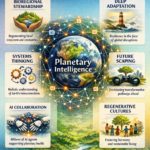
The Near-Future of Planetary Intelligence
Looking at Allie K. Miller, and considering my role at Possible Planet Lab, suggest what’s next for us. Then create an infographic of the key elements of planetary intelligence, taking into account the work of Michael Haupt and Alex Steffen. After producing the infographic, provide a detailed but succinct written commentary on where things stand in the field of planetary… Read more →
How Can We Understand Ourselves Better?
I’d like to think about planetary intelligence as getting to know and understand ourselves better, from the planetary down to the bioregional, local, and personal level. If we can make available to everyone a sense of the whole—of Gaia, a miracle even without the fake spiritual trappings that some claim to have special access to—of the planet and all her… Read more →
The Next Step
It seems to me that the next step for the lab is to develop a community of interest around the idea of planetary intelligence. It makes sense to have that be bioregional, as one of the first tasks is to build a practical example of bioregional intelligence using the Genesee Finger Lakes region. I’d like to extend an invitation to… Read more →
The Intelligence of Nature
Below is a synthesized, cross-disciplinary account of what we actually know—scientifically, philosophically, and empirically—about the intelligence of nature, and where the boundaries of that knowledge still lie. What We Know About the Intelligence of Nature 1. Nature is not random; it is organized, adaptive, and problem-solving Across biology, ecology, and Earth system science, one conclusion is no longer controversial: natural… Read more →
Gemini on “Building Bioregional Intelligence”
Building bioregional intelligence is the practice of developing a “terrain of consciousness”—a collective ability for communities to see, think, and act as part of their local ecological systems. It shifts focus from arbitrary political borders to natural boundaries like watersheds, soil types, and climate patterns to organize human activity regeneratively. Core Components of Bioregional Intelligence Watershed Consciousness: Understanding life through… Read more →
Building Bioregional Intelligence, Part 2 (Actually a Prequel)
Below is a conceptual prologue—deliberately non-technical in tone, but rigorous in scope—that can introduce later material on dashboards, data architectures, and AI-enabled commons. It is written to stand on its own as a framing essay on Building Bioregional Intelligence, using the Genesee Finger Lakes (GFL) as an illustrative case without treating it as exceptional. Building Bioregional Intelligence A prologue From… Read more →
Building Bioregional Intelligence
Looking at https://gflbioregion.org, and reviewing what has been generated about planetary intelligence at https://possibleplanetlab.org, what’s the best way that we can demonstrate what it means for the Genesee Finger Lakes to become a node in a planetary bioregional network? Can we generalize the “bioregional health” framework set out at https://gflbioregion.org? Can we generate a framework for a bioregional knowledge commons… Read more →